EN







When the gap is 0.2 mm and there's no room for a normal gasket
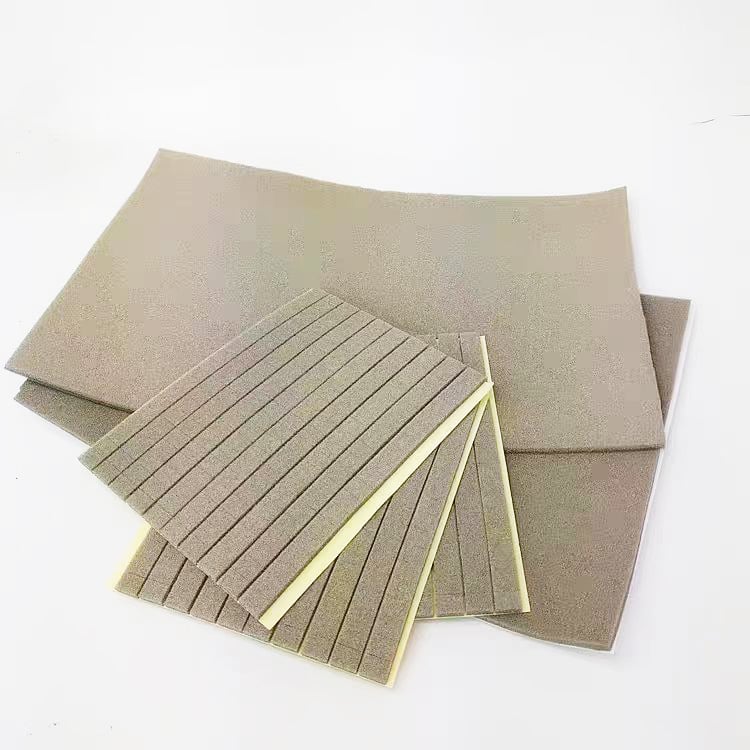
There's a moment in every slim-product program where the ID team hands over the mechanical stack-up and the EE team finds a 0.15–0.20 mm gap that still has to carry ground. The usual answers are a stamped metal shrapnel — expensive, sharp enough to nick the FPC on the way in, and plated on a line we don't control — a plated fabric patch that takes a set inside a year, or a finger stock that simply won't fit. That's the problem the Johan ECF Semi-Fold (SF) series was built for. It's an adhesive EMI shielding conductive foam gasket engineered for ultra-thin-space grounding: the kind of job where a standard FOF part won't compress, a shrapnel costs three times as much, and a generic conductive foam gasket off the catalog doesn't have the force profile you need.
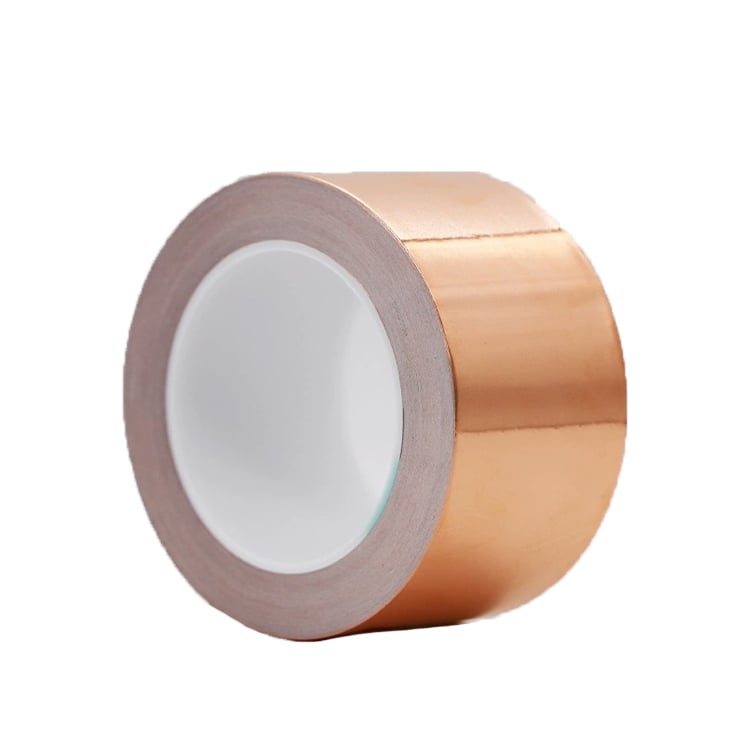
It also carries ESD protection off the bezel and bleeds stray electromagnetic interference away from the antenna feed — but if that's all you need, a plain copper foil tape will do it cheaper. Where the SF series earns its price is when the gap, the force budget, and the pad size all collide at once.
What makes this build different
The construction is deliberately skinny. A high-rebound elastomer core is wrapped in a super-thin conductive fabric or film (0.032 mm Ni/Cu polyester taffeta, or a gold-plated option), and the whole part lands at a working height of 0.20, 0.30 or 0.33 mm. Through-resistance starts around 0.18 Ω at zero compression on a 5×5 mm pad and drops to roughly 0.05 Ω at 50% compression — which means when housing tolerances leave you a little more or less gap than designed, the ground connection doesn't wander. The structure is protected under patent CN206619706U.
We don't load metal particles into the foam the way cheaper sponge elastomer gaskets do. A particle-loaded core feels conductive on a meter but leaks across a flexed housing, because the particle network breaks the moment the foam bends. Wrapping a continuous fabric face around a rebound core gives you a real conductive skin on every mating surface — that's why the SF series holds its numbers after thermal cycling instead of drifting upward.
Why low CFD is the whole point
On an LCD or OLED stack, you don't get to push. Push too hard on the cell and you get mura, uneven color, or a cracked corner. So the SF series is tuned to a compression force deflection under 100 kPa at a 0.15 mm gap — low enough that the gasket beds down without loading the panel, but high enough that it keeps reliable contact even when the bezel flexes. Compare that to a stamped shrapnel, which has to push back hard enough not to back out of its pocket; on a thin display, that push is exactly what you're trying not to apply.
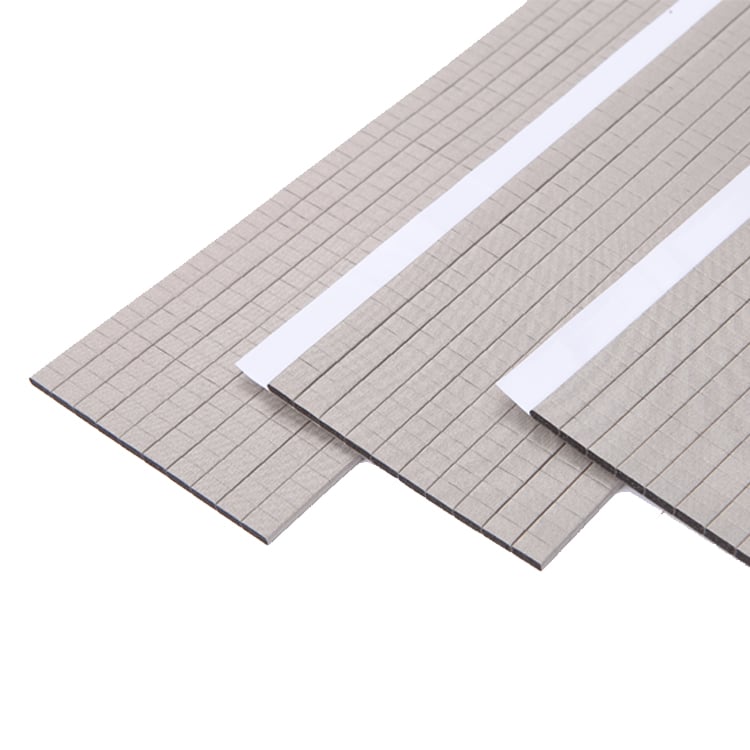
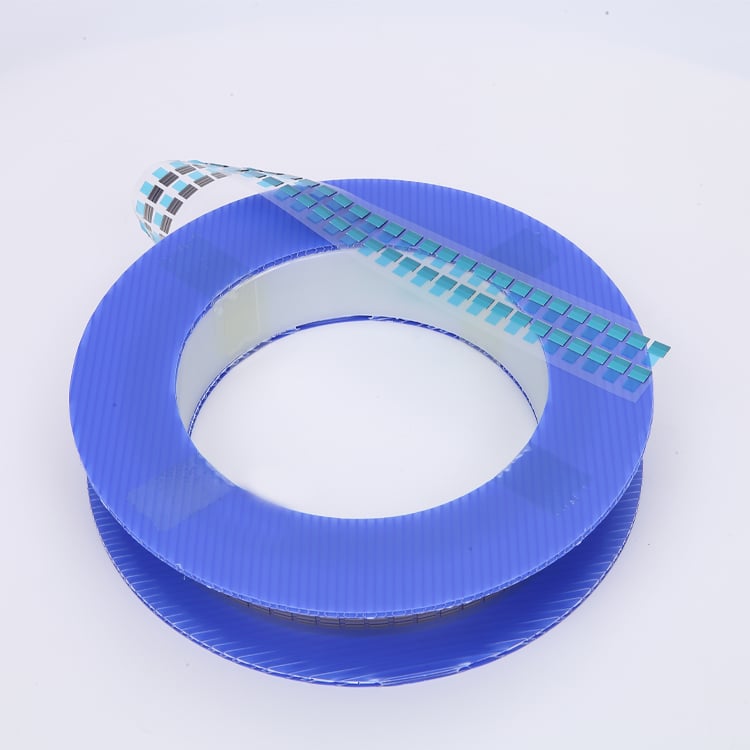
That force curve is also what lets us replace a shrapnel in gaps ≤ 0.20 mm without redesigning the pocket. The die cut sponge sits where the stamped part used to live, but it ships as a tape on a roll, picks up on your SMT or semi-auto line, and doesn't leave burrs on the floor.
Where the SF series actually shows up
We won't list every industry on this page. These are the four jobs we see every week:
- RF antenna grounding on the main board. Antenna tuning hates a ground contact that drifts after temperature cycling. After 12 cycles of −20 to 80 °C at 85% RH, our through-resistance on a 5×5 mm pad is still 0.20 Ω at 0% compression and 0.06 Ω at 70% — within reach of the as-built number, not a runaway. Stable, low resistance is the whole spec line.
- LCD / OLED grounding along the bezel. This is the 2×8 mm × 0.60 / 0.85 mm standard part you'll see in the table below. For high-refresh-rate panels (90 Hz and up), we'll steer you to the Au-plated fabric option. Gold doesn't tarnish, so contact resistance stays flat over product life instead of creeping up as nickel oxidizes — a detail most people only notice after a display starts ghosting two years out.
- Shrapnel replacement in any gap ≤ 0.20 mm. The pocket drawing you used for the stamped part works as-is on most programs. We'll die-cut to your outline, and the rebound force is low enough that the bezel doesn't see it as a load.
- Very small grounding pads (≤ 5 × 5 mm). On pads that small, our measured through-resistance runs about 90% lower than a plated-conductive foam alternative. That's the number that lets you shrink the ground island on the PCB and free up real estate for a connector.
Why this SKU exists at Johan
We started in 2011 supplying conductive materials to 2G/3G handset makers. By 2017, when full-screen and foldable Android phones arrived, gap budgets collapsed from ~0.5 mm to ~0.2 mm and off-the-shelf EMI gaskets simply stopped fitting. We spent two years iterating the core formulation and the wrap geometry to bring CFD down and rebound up — that work became the SF series, and it's still a line we coat and convert ourselves in Dongguan.
A practical consequence: because we run our own magnetron sputtering gold-plating line in Shandong, the Au-plated fabric option isn't a special-order item with a six-week lead time. It's the same roll-to-roll process we've run since 2020, when we became the first domestic supplier to plate gold and copper continuously onto fabric. When your display customer wants a prototype next week, that matters.
We're also an IATF 16949 shop, so if this part ends up in an in-cabin display or a telematics unit, we have the PPAP and the traceability file already built.
Working with us
- Send us the gap (nominal and tolerance), the panel thickness, and whether the mating surface is a metal bezel or a plated PCB pad. We'll come back with a recommended working height and fabric finish rather than just quoting the catalog.
- Standard LCD/OLED parts ship as 2×8 mm × 0.60 or 0.85 mm on a roll. Non-standard outlines are die-cut to your DXF; first articles usually leave Dongguan in 7–10 working days.
- If you're upgrading an existing shrapnel design, send us the pocket drawing. We'll model the compression deflection and tell you whether the SF build clears it before we cut tooling — no point spending money on a die for a part that will bottom out.
- Storage and operating range: −20 to 80 °C long-term, 12-month shelf life at 18–26 °C and 45–65% RH, FIFO. We pack on silicone release liner in static-shielding PE so the conductive PSA doesn't pick up dust on your line.
If your problem is a gap too thin for a normal EMI shielding gasket, a force too high for a display, or a ground pad too small for anything off the shelf, this is the SKU to start with. Send the stack-up — we'll tell you honestly whether the SF series fits, or whether you're better off with one of our thicker FOF builds, a copper foil tape, or a custom geometry we haven't quoted yet.
ECF-SF Series — Typical Values
Representative only, not for specification purposes. Test sample: 5 × 5 × 0.60 mm on 0.032 mm Ni-plated fabric.
Through-resistance vs. compression (as built)
Compression |
0% |
30% |
50% |
70% |
Through-resistance (Ω) |
0.179 |
0.080 |
0.051 |
0.045 |
After 12 cycles, −20 °C ↔ 80 °C, 85% RH (2 h/cycle)
Compression |
0% |
30% |
50% |
70% |
Through-resistance (Ω) |
0.201 |
0.115 |
0.070 |
0.058 |
Standard LCD / OLED parts (2 × 8 mm × 0.60 / 0.85 mm)
Part number |
Fabric finish |
Working height |
ECF-SF-05S3 |
Ni-plated |
0.20 mm |
ECF-SF-07S3 |
Ni-plated |
0.30 mm |
ECF-SF-05S3GP |
Au-plated |
0.20 mm |
ECF-SF-07S3GP |
Au-plated |
0.33 mm |
Other dimensions available on request. Gold-plated fabric is recommended for high-refresh-rate LCD/OLED applications where long-term contact stability matters.


(Working Height: 0.20mm ECF-SF-05S3 Fabric-Ni-Plating)

(Working Height: 0.30mm ECF-SF-07S3 Fabric-Ni-Plating)

(Working Height: 0.20mm ECF-SF-05S3GP Fabric-Au-Plating )

(Working Height: 0.33mm ECF-SF-07S3GP Fabric-Au-Plating)