EN







Introduction
Walk into almost any EMC lab today and you'll see the same scene: a clean schematic, a tight chassis, a board that sails through every bench test — and then fails radiated emissions at 1.8 GHz because the seam between the shield can and the housing is sitting 0.2 mm too proud, or the ground path has doubled its resistance after one summer in the field. We've spent fifteen years watching customers fight exactly that problem, and the adhesive EMI conductive foam gasket on this page is the part we keep coming back to.
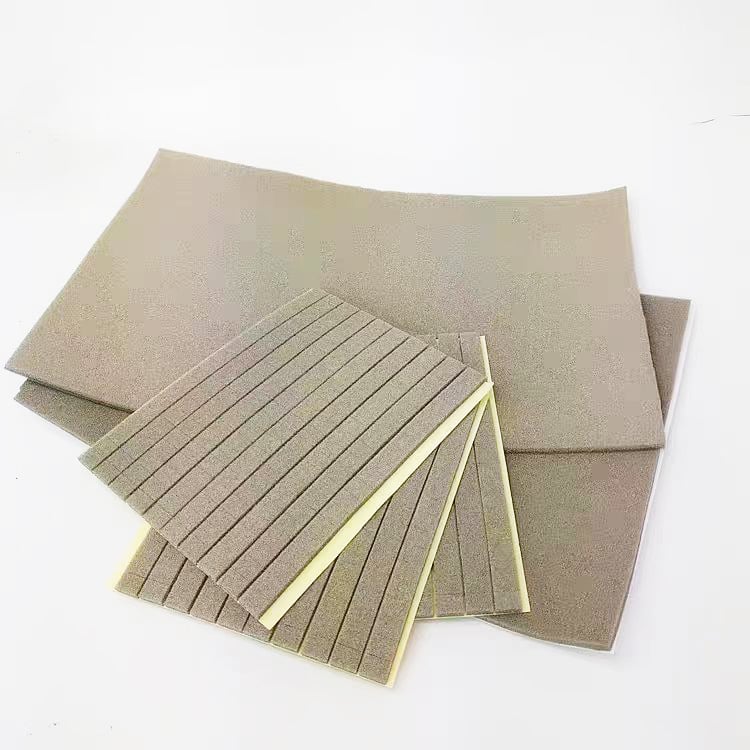
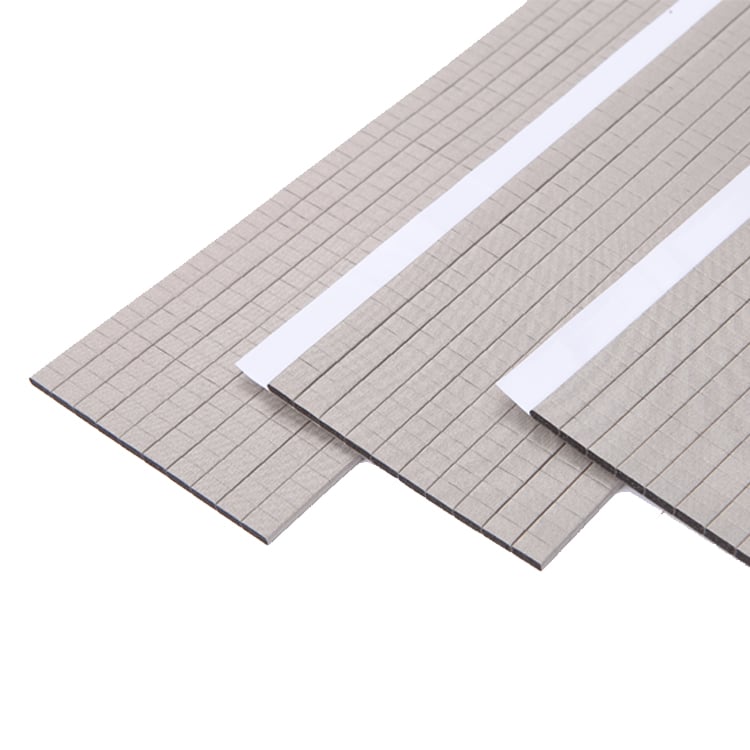
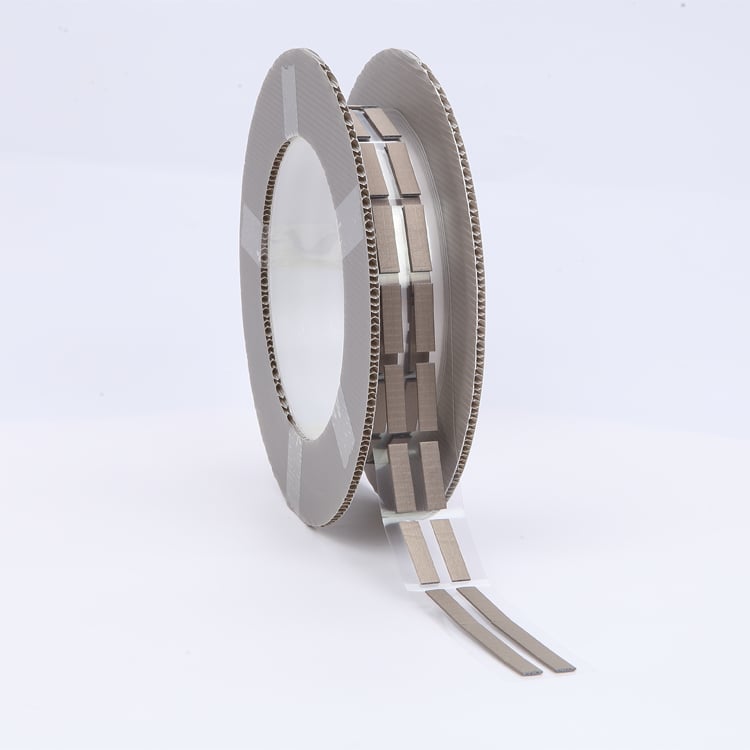
This isn't a rubber gasket loaded with metal fillers. It's a fabric-over-foam (FOF) construction: a nickel/copper plated polyester taffeta wraps a soft polyurethane (or, on request, soft silicone) foam core, with a conductive pressure-sensitive adhesive on the bottom. That three-layer sandwich is what lets it compress 15–30% and still rebound, hold a surface resistance under 0.05 Ω, and deliver 70 dB shielding from 10 MHz to 3 GHz — enough to handle both the electromagnetic interference your radiated-emissions test throws at it and the RF immunity your EMC compliance sign-off demands. It also doubles as an ESD protection path off the housing, so static doesn't walk onto a sensitive CMOS line during assembly or service. It's the same architecture we first productionized for foldable Android phones back in 2017, when "fold foam" was still a domestic novelty and only a handful of Japanese suppliers could wrap it cleanly at volume.
What the part actually looks like
The standard build is 0.08 mm or 0.12 mm Ni/Cu taffeta over 0.5 / 1.0 / 1.5 / 2.0 mm urethane foam, laminated to a 0.08 mm conductive double-sided tape (≥12 N/25 mm adhesion, through-resistivity under 0.05 Ω). The foam carries a UL 94 V-0 / HF-1 flame rating, ships black as standard, and we hold compression set to 5–10% after 22 h at 70 °C. If your spec calls for a wider temperature window, we'll switch the core to soft silicone foam; if you need better skin-effect performance above 6 GHz, we'll swap the taffeta for a copper or aluminum film face.
The die-cutting is where most of our engineering conversations actually happen. The outline on your drawing matters less than the land pattern: how wide the contact path is on the chassis flange, whether there's a via-pad the gasket has to bridge, and how much compression your housing stack-up really tolerates. A lot of customers send us a 2D DXF and we send back a revised outline, because a gasket that looks fine on paper will leak the moment it sits under a PCB shield can that flexes. We also ultrasonic-weld (or adhesive-bond) the wrap seam rather than relying on a lap joint — that's the failure point we kept seeing on cheaper imported FOF parts, and the reason we started doing import substitution on this SKU in the first place.
Why engineering teams keep specifying this one
We're not going to tell you every conductive foam gasket on the market is identical and ours is cheaper. The honest reasons buyers stay with us:
- Rebound after thousands of cycles. Compression set on the standard urethane build runs 5–10%, which means after a five-year consumer-product life the gasket still holds 20–30% compression — enough to keep the ground contact from opening up. That number matters far more than the peak dB figure, because a gasket that takes a set is a gasket that fails radiated emissions three years out.
- One part covers EMI and ESD. The Ni/Cu fabric surface bleeds static off metal housings before it can walk onto a sensitive CMOS line, so you don't need a separate ESD vent or separate finger stock. On an I/O port for a server or base station, that's one less assembly step and one less BOM line.
- Adhesive that survives reflow. The conductive PSA is coated in-house on our Hunan line (10,000 m² of coating capacity). It holds up through a short SMT reflow profile and the −20 °C to 80 °C long-term operating range your automotive customer will write into the spec. Repositionable in the first few seconds, then it locks.
- We convert in the same building we coat in. Plating, coating and die-cutting all sit under one IATF 16949 / ISO 9001 / QC 080000 quality system, which is why a modified outline turns around in 7–10 days for a first article rather than six weeks.
Where it actually earns its keep
The long list of industries on most gasket pages — aerospace, medical, military, every sector — isn't where we do our best work. This EMI shielding gasket shows up in:
- Game consoles: the long perimeter ground between the metal top case and the mid-frame, right where the RF front-end sits. Replacing a soldered shield-can frame with a die-cut conductive sponge ring drops assembly time and lets service techs open the unit without destroying a weld.
- Smartphones and wearables: around application processors and PMICs, where a 0.5 mm tall FOF ring stands in for a rigid shield can. It's the form factor we first tooled for a tier-1 Android customer in 2017 and have iterated on every year since.
- Servers, base stations and network appliances: on the I/O panel and around slot covers, where leakage at the HDMI or Ethernet port is what fails your FCC / CE radiated test.
- New-energy vehicles: inside DC-DC converters and OBC enclosures, where vibration and a wider thermal range push customers toward the soft-silicone foam build. We've been iterating EV-grade components on this line through 2024.
We've done medical and avionics work too — but if your project is a life-critical implant or a flight-critical box, you should probably be talking to a vendor whose whole catalog is qualified to DO-160. We'll say that upfront rather than quote you a price we can't back.
Why Johan Material
We're not a trading house rebranding someone else's foam. Since 2011 we've run a vertically integrated EMI/EMC materials shop — the only domestic supplier we're aware of that combines electroplating (our Shandong magnetron-sputtering line does continuous gold and tin plating on fabric), coating (the Hunan plant), and die-cut conversion (Dongguan and Shenzhen) under one roof. In 2022 the Chinese Ministry of Industry and Information Technology named us a national-level specialized and "little giant" enterprise. Today we hold 12 Chinese and 2 US invention patents, plus 30 utility models. One of them — a heat-activated low-tack waterproof foam tape granted in May 2025 (CN222846656U) — directly fixes the residual copper-foil transfer issue people run into when they laminate conductive film over foam at high volume.
Practically, that means when your shielding effectiveness drops 5 dB on a trial lot, the complaint doesn't route through three middlemen. The coating engineer who set that lot is the person on the call.
Working with us
- Samples: send us a DXF or drawing, your required compression, and the frequency band you're actually worried about. We'll suggest a build rather than just quoting the catalog. First articles usually ship in 7–10 working days.
- Production lead time: 2–3 weeks after PPAP sign-off, depending on outline complexity.
- Storage: one-year shelf life at 18–26 °C and 45–65% RH, FIFO. We pack on silicone release liner and bag in static-shielding PE so the conductive adhesive doesn't pick up dust on your SMT line.
- Export terms: FOB Shenzhen / Yantian; we work routinely with CIF, DDP and express samples. We ship the CES and electronica booth out of our Shenzhen office twice a year if you'd rather talk in person.
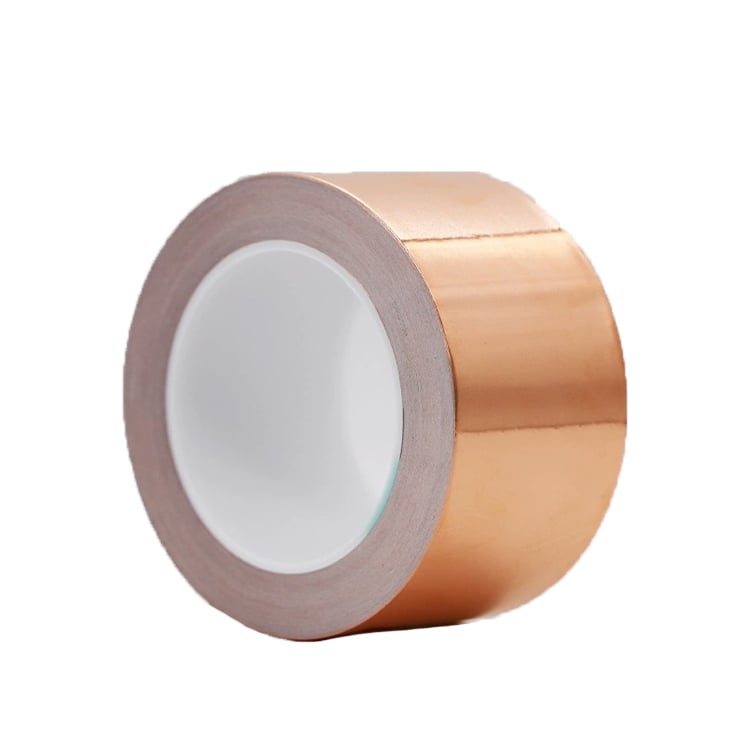
If you're specifying an EMI conductive foam gasket for a consumer, networking or EV enclosure, the short version is: send us the drawing. We'll tell you honestly whether the catalog part works, whether you need a modified build, or whether a different product in our line — a copper foil tape, say, or a 3D conformal shield — will solve the problem better. And we'll put numbers behind the recommendation.
Standard Spec Table
Conductive Film / Fabric
Type |
Thickness (mm) |
Surface Resistivity |
Shielding (10 MHz – 3 GHz) |
Ni/Cu polyester taffeta |
0.08 / 0.12 |
< 0.05 Ω |
70 dB |
Foam Core
Type |
Compression Set |
Color |
Flame Retardancy (UL 94) |
Urethane / soft silicone |
5–10% |
Black |
V-0 / HF-1 |
Conductive PSA Backing
Type |
Thickness (mm) |
Through Resistivity (Ω) |
Adhesion (N / 25 mm) |
Conductive double-sided tape |
0.08 |
< 0.05 |
≥ 12 |
- Operating temperature: −20 °C to 80 °C long-term; performance degrades outside this window.
- Shelf life: 12 months at 18–26 °C, 45–65% RH, FIFO.