
 EN





When BeCu finger stock stops being the easy answer
Walk through a telecom equipment factory and you'll still see beryllium-copper finger stock on every cabinet seam. It's been the default since the 1970s, and it works — until you price it out, or a customer's EHS team flags the beryllium dust, or a casting comes off the mold with 0.3 mm of warp that no finger stock will seal against. Over the last decade, a lot of that seam has moved to a conductive fabric over foam gasket — a Ni/Cu taffeta-wrapped foam strip, die-cut to the cabinet drawing, stuck on with a conductive PSA. It's lighter, cheaper, doesn't contain beryllium, and it forgives the casting flatness that finger stock doesn't. This page is the build we ship for switches, routers, base stations and data center cabinets.
This isn't the same SKU we show for game consoles and smartphones. The enclosure scale is different, the service model is different, and the environmental spec is different. Read on.
Why networking is a different job
On a game console or a phone, the gasket is 5 mm wide, lives inside a closed enclosure, and gets compressed once at the factory. On a networking equipment cabinet, the same gasket can run three meters long, sits on a cast aluminum flange that warps 0.2–0.3 mm across its length, and gets compressed and uncompressed every time a technician pulls a line card for service. That changes the engineering spec:
- Compression set has to stay low across 10+ years of service, not the five-year life of a phone.
- The wrap seam has to survive repeated flexing as the card slides in and out — a lap joint opens; an ultrasonic-welded seam doesn't.
- The adhesive has to hold across −40 to 85 °C on indoor cabinets, or −40 to 55 °C outdoors, plus sustained humidity.
- Long runs have to splice or butt-joint cleanly, because a three-meter seam that leaks at the joint is worse than no gasket at all.
Where this build actually ships
We'll skip the generic "enterprise, service provider, industrial" list. These are the four jobs we quote every week:
- Line card and switch front panels. Between the card faceplate and the chassis, a continuous FOF strip contains the EMI from the switch ASIC and keeps adjacent cards from talking to each other. Replacing finger stock here is the most common switch we've made in the last five years.
- Base station radio units (RRU / AAU). Between the radio head housing and its mounting bracket, or between the radio and the antenna radome. The gasket has to hold through outdoor temperature cycling and wind vibration without opening a 0.1 mm gap at the seam — that gap is where your radiated emissions test fails.
- Cabinet and rack seams. Along the vertical seams of a 19-inch rack, between the cabinet door and the frame, and around cable entry cutouts. The foam seals dust and bleeds static to the rack ground.
- I/O panel and cutout shielding. Around RJ45 cages, fiber-optic adapters and power entry modules. The common-mode current that radiates off an unshielded I/O cutout is exactly what fails radiated emissions on a switch — and it's the easiest thing to fix with a die-cut frame.
- Outdoor street-side cabinets and small-cell housings. Where the gasket has to survive UV, rain and thermal cycling for 15+ years. For these we move the core from urethane to silicone and specify a UV-stabilized fabric finish.
Why FOF over the alternatives
We'll tell customers this before they ask:
- vs BeCu finger stock: no beryllium dust, no torque-controlled installation, conforms to warped castings, typically 30–50% lower landed cost. The trade-off is lower peak shielding above 6 GHz — for most networking cabinets that's not in-band.
- vs metal mesh gaskets: lighter, doesn't mar the casting, field-replaceable without special tools.
- vs carbon sponge: 70 dB shielding instead of 40–60 dB, and the fabric wrap doesn't shed conductive carbon dust into the equipment airflow.
- vs fabric tape on a roll: die-cut to a continuous outline with registration tabs, alignment features and cutouts — not a technician's best guess with a razor blade.
If your application is one of those edge cases where finger stock genuinely wins (very high frequency, very low compression available, or a military spec that still calls out BeCu), we'll tell you.
Why Johan for networking
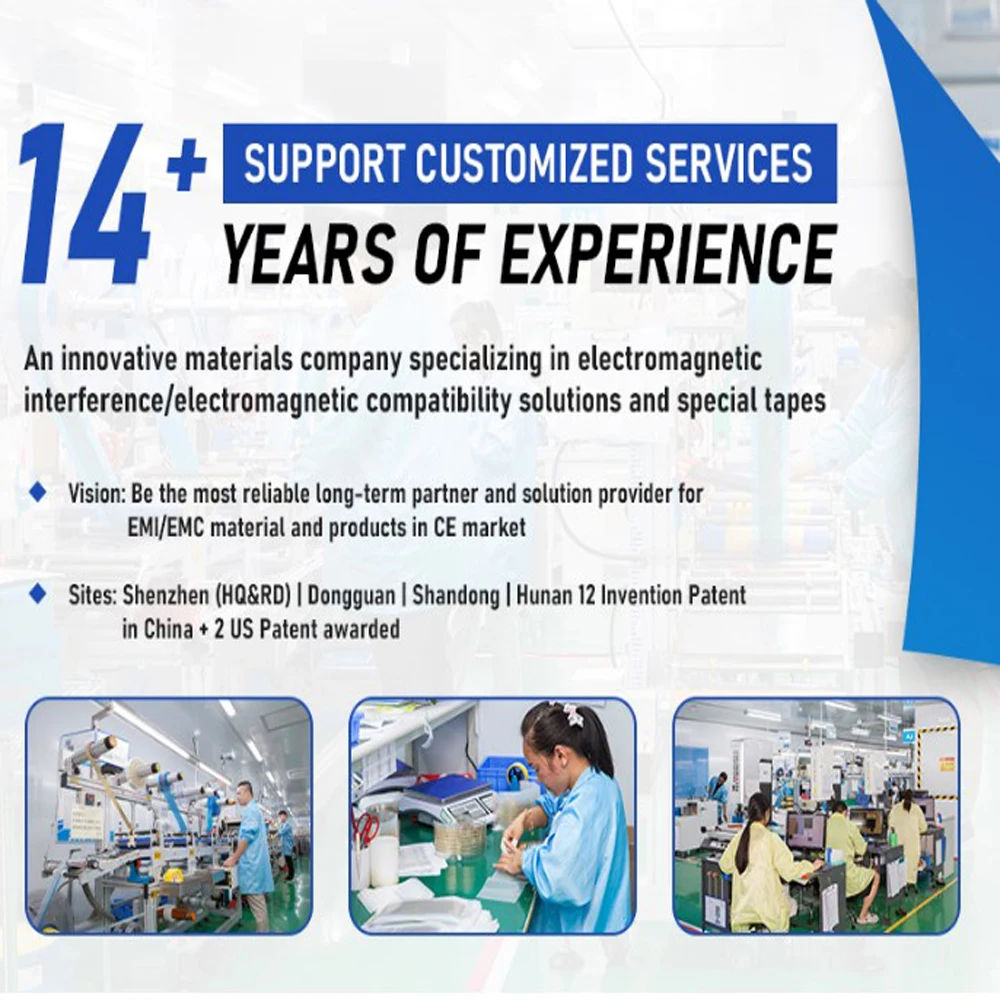
We've been serving communication networks since the 2G/3G era — 2011, when we started out supplying conductive materials to handset makers. By 2019 we'd brought our high-performance tape coating line online in Hunan, and in 2023 we split Shenzhen R&D from Dongguan conversion specifically to run longer cabinet-length gaskets without compromising die tolerance. We don't import converted FOF rolls and reskin them; we wrap the taffeta ourselves in Dongguan, ultrasonic-weld the seam rather than rely on a lap, and die-cut to your outline.
For outdoor and carrier-grade work, we run Telcordia-style environmental qualification — temperature cycling, humidity soak, vibration — and the lot-traceability file exists if your customer asks for it. We're ISO 9001 and ISO 14001; IATF 16949 is also in place if the same part shows up in a telecom-related vehicle application.
Working with us
- Send us the cabinet drawing, the flange width, the compression available, and the indoor/outdoor classification. We'll recommend foam core (urethane for indoor, silicone for outdoor) and fabric finish.
- Standard cross-sections 1.0 / 2.0 / 3.0 / 5.0 / 6.4 mm; long runs spliced up to 3 m; die-cut outlines with tabs and alignment features to your DXF. First articles leave Dongguan in 7–10 working days.
- If you're qualifying a new switch platform, we'll send first articles on a trial lot so your mechanical team can run the seam on an actual casting before we cut hard tooling.
- Storage: 12 months at 18–26 °C, 45–65% RH, FIFO.
If your cabinet is still running BeCu finger stock and you're tired of quoting beryllium EHS paperwork, send us the seam drawing. We'll tell you whether a die-cut FOF clears the shielding budget, or whether you're actually better off with finger stock on one section and FOF on the rest — most cabinets end up that way, and we'll quote both.
Typical Values — Networking-Grade Fabric-over-Foam Gasket
Representative values, not for specification purposes. Final build is application-specific.
Item |
Indoor build |
Outdoor build |
Fabric |
Ni/Cu polyester taffeta |
Ni/Cu taffeta, UV-stabilized finish |
Foam core |
Polyurethane ether |
Silicone foam |
Standard cross-sections |
1.0 / 2.0 / 3.0 / 5.0 / 6.4 mm |
1.0 / 2.0 / 3.0 / 5.0 mm |
Surface resistance |
< 0.05 Ω / sq |
< 0.05 Ω / sq |
Shielding effectiveness |
70 dB (10 MHz – 3 GHz) |
70 dB (10 MHz – 3 GHz) |
Compression set |
≤ 10% after 22 h at 70 °C |
≤ 10% after 22 h at 125 °C |
Operating temperature |
−40 °C to 85 °C |
−40 °C to 55 °C (continuous) |
Seam construction |
Ultrasonic-welded wrap |
Ultrasonic-welded wrap |
Standard lengths |
Up to 3 m, spliced |
Up to 3 m, spliced |
Quality system |
ISO 9001, ISO 14001, QC 080000 |
Same |
Stepping down: carbon sponge for budget cabinet ESD sealing, SF series for sub-0.5 mm gaps, aluminum foil tape for heat-spreading panels. Tell us the flange, the compression and the environment — we'll match the build to the cabinet.


