EN


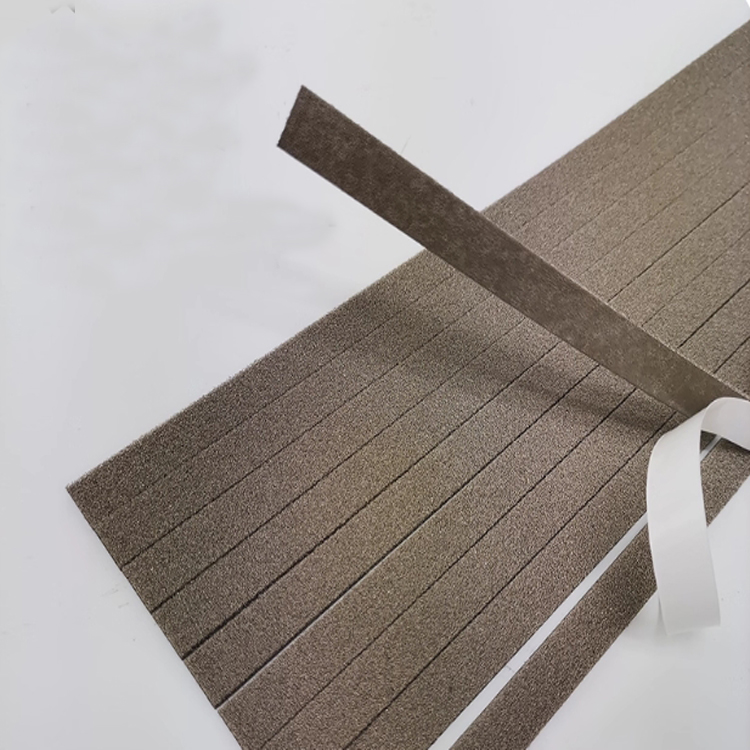





Not every seam needs a 70 dB gasket
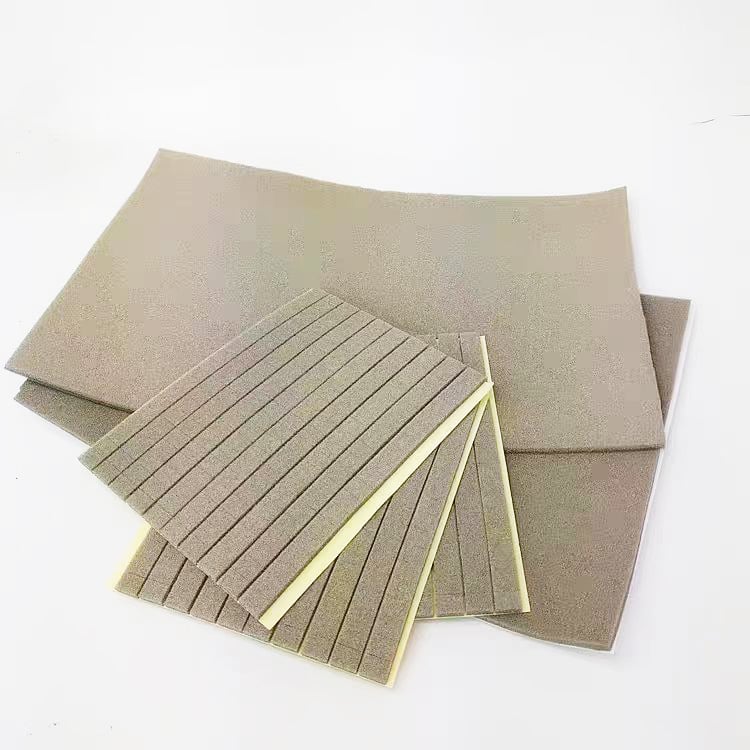
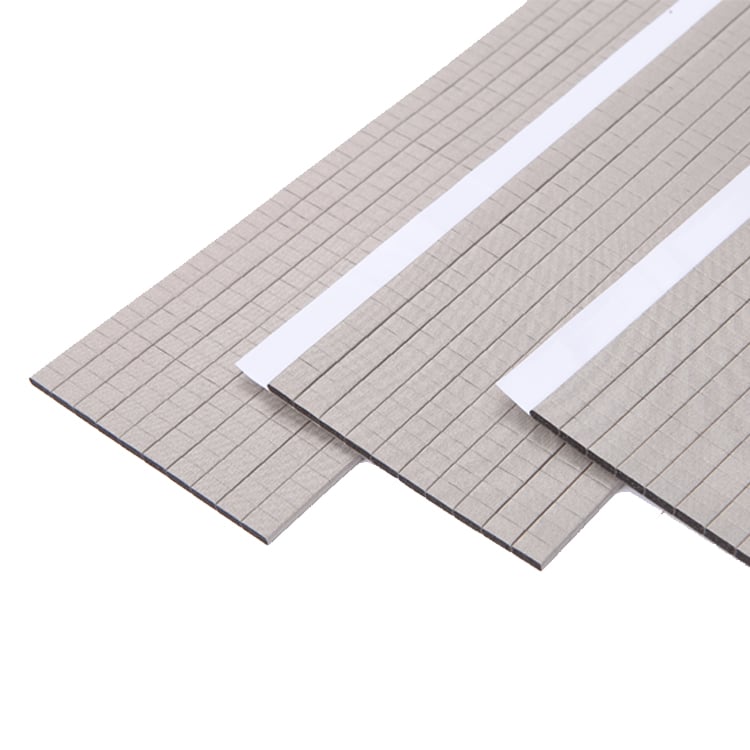
Walk through the shielding section of any BOM review and you'll see the same temptation: spec a fabric-over-foam gasket on every seam because "we might need it." Most of those seams don't need 70 dB. They need a part that bleeds static off a cabinet panel, stops dust getting into a slot, and doesn't blow the unit cost. That's the black conductive shielding sponge foam gasket — a carbon-loaded polyurethane ether foam, die-cut to shape, with a conductive acrylic adhesive on the back. It's the entry-level shielding part in our lineup, and for a lot of cabinet, enclosure and ESD-drainage jobs it's the right one.
If you've been searching for a conductive sponge gasket for general signal protection, this is probably what you're looking for — not the premium FOF build we show on other pages.
What this part actually is
Don't confuse it with the fabric-over-foam gaskets elsewhere on our site. Those wrap a Ni/Cu taffeta around a foam core to hit 70 dB from 10 MHz to 3 GHz. This one doesn't. The conductivity here comes from carbon black loaded directly into the urethane foam — the whole part is black because it's carbon, not because of a plating. Surface resistance lands in the 10²–10⁴ Ω/sq range, shielding effectiveness in the 40–60 dB band depending on frequency and compression. That's not a spec defect; that's the spec. It's the number you need for a cabinet seam, an I/O cutout, or an ESD drainage path — not the number you need around a high-speed SerDes pair.
The advantage is the tradeoff nobody puts in marketing copy: because there's no metal coating to crack, tarnish or wear off, the part behaves the same on day 1 and on day 1,800. It shrugs off humidity, it doesn't corrode in a coastal deployment, and it's roughly a third of the landed cost of an equivalent FOF gasket. It's also lighter, which matters on a rack already carrying 200 kg of switches.
When this is the right part
We'll skip the generic "aerospace, medical, military" list. These are the four jobs we ship this build into every week:
- Cabinet and rack seams in networking gear. A 5–10 mm die-cut strip between cabinet halves seals dust and bleeds static to the rack ground. You don't need finger-stock-level shielding on a sealed rack; you need continuity that survives rack vibration and a five-year warranty.
- ESD drainage in plastic enclosures. A strip along the inside of a plastic chassis where a service technician's wrist might brush it creates a controlled static path to ground, instead of letting a discharge walk onto a CMOS line on the way in.
- Cost-sensitive consumer products where FOF would be overkill. Set-top boxes, smart speakers, small appliances — anything where the BOM cost per unit is tight and the radiated-emissions limit is at 3 m rather than 10 m. This part gives you most of the EMI shielding at a fraction of the FOF cost.
- Combined dust seal and ground. The foam is semi-closed-cell, so it stops dust ingress at the same time it bleeds static. You don't need a separate rubber gasket plus a separate grounding strip — one die-cut part does both.
When this is the wrong part
We tell customers this before they place a sample order:
- If you need 60 dB above 1 GHz, step up to the FOF gasket. Carbon foam physically can't get there.
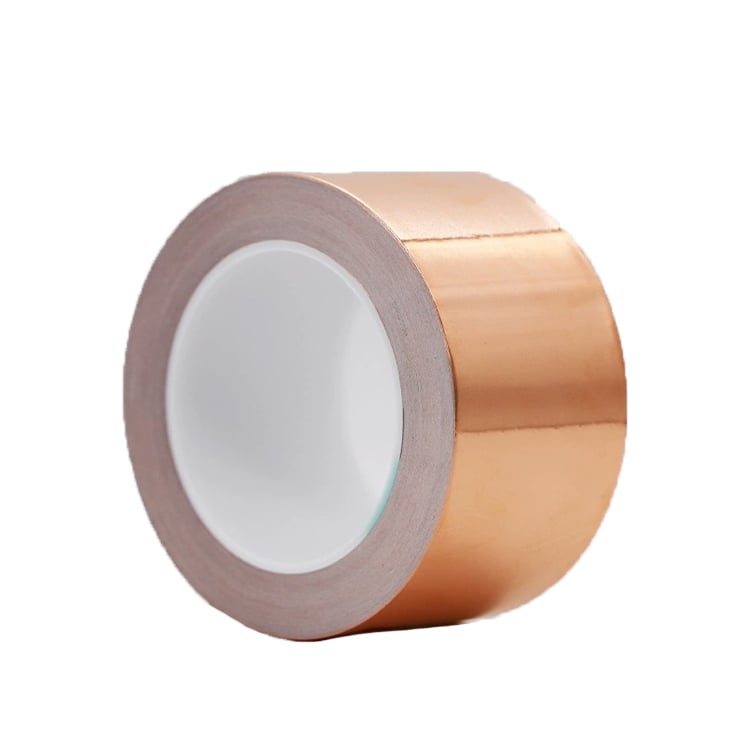
- If you're wrapping a high-speed HDMI or USB4 connector, use the Ni/Cu fabric tape — carbon's surface resistance is too high for a low-impedance I/O bond.
- If your gap is under 0.2 mm, the semi-fold SF series is the build.
- If you need 230 °C continuous service, this isn't it — the PI insulation tape is.
This product has a job, and that job isn't replacing the rest of the catalog.
Why Johan converts this in-house
We die-cut this in Dongguan. It's not a product we import and reskin — it's the budget SKU in the same lineup that includes our premium FOF gaskets, and it runs through the same ISO 9001 / IATF 16949 lot-traceability system. When a networking customer calls with a failed cabinet seam, we can pull the lot number and tell them which foam batch it came from, what the measured surface resistance was, and which shift converted it. That's worth more on a failed rack than any spec sheet.
Because the conductivity is loaded into the foam itself rather than coated on top, there's no metal-coating consistency problem of the kind that plagues cheaper plated-foam imports — a rolled-off edge doesn't suddenly turn non-conductive. We also run the adhesive coating on our Hunan line, so the conductive PSA is matched to the foam rather than glued on by a third party.
Working with us
- Standard thicknesses 1.0 / 2.0 / 3.0 / 5.0 mm; die-cut to your DXF. First articles leave Dongguan in 7–10 working days.
- Send us the gap, the compression you can tolerate, and the surface you're bonding to. We'll tell you honestly whether carbon foam clears it or whether you need to step up to FOF.
- RoHS and REACH compliant. If the part ends up in a vehicle — say, an internal cabinet seal in an OBC enclosure — we're IATF 16949 and the PPAP file is ready.
- Storage: 12 months at 18–26 °C, 45–65% RH, FIFO. We pack on silicone release liner in static-shielding PE.
If your shielding BOM is being driven by FOF gaskets on seams that don't need them, send us the layout. We'll tell you which seams can drop down to carbon sponge and which ones genuinely need the 70 dB part — and we'll put numbers on the shielding budget so you're not spec-ing expensive shielding on every seam just in case.
Typical Values — Carbon-Loaded Conductive Sponge Foam Gasket
Representative values, not for specification purposes.
Item |
Typical value |
Construction |
Carbon-black loaded polyurethane ether foam, black |
Surface resistance |
10² – 10⁴ Ω / sq |
Shielding effectiveness |
~40 – 60 dB (frequency- and compression-dependent) |
Standard thicknesses |
1.0 / 2.0 / 3.0 / 5.0 mm (custom on request) |
Adhesive |
Conductive acrylic, pressure-sensitive |
Compression set |
≤ 15% after 22 h at 70 °C |
Operating temperature |
−20 °C to 80 °C long-term |
Compliance |
RoHS, REACH |
Stepping up: Ni/Cu fabric-over-foam (FOF) for 70 dB, semi-fold SF series for gaps ≤ 0.2 mm, Ni/Cu fabric tape for flexing I/O seams. Tell us the frequency band and gap — we'll match the part to the job.