EN


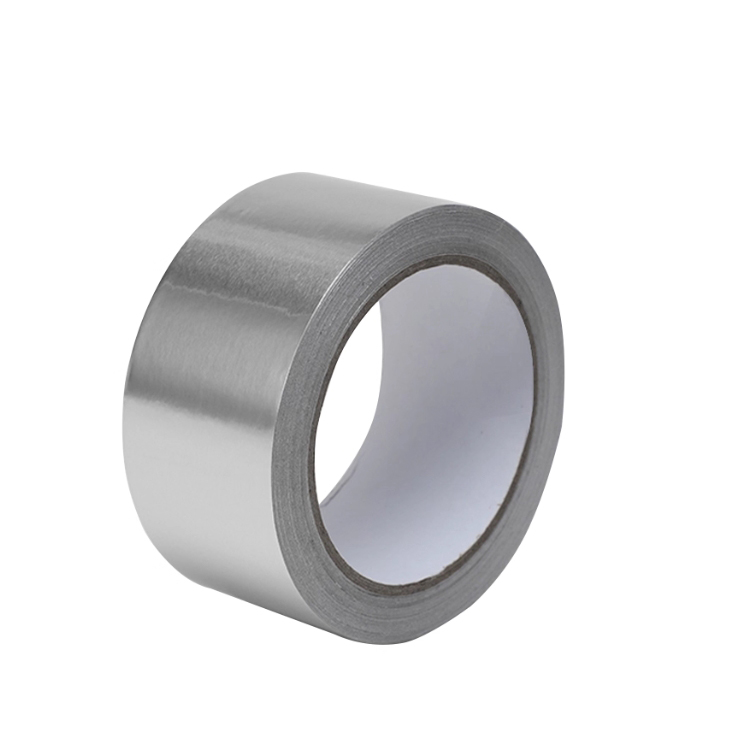





When one part has to spread heat and block RF at the same time
There's a job that comes up on almost every power-electronics program: you need to move heat away from a switching regulator or an inductor, and you also need to keep the switching noise from radiating off the housing. A heat sink solves the first problem. A fabric tape solves the second. But when you're trying to do both with one part on a tight BOM, the answer is usually a conductive aluminum foil tape. Aluminum's thermal conductivity sits around 205 W/mK — roughly 60% of copper — and its natural electrical conductivity makes it a decent Faraday layer on its own. Stick it on a power module, over a cable bundle, or across a plastic wall that needs to both spread heat and block RF, and you've combined two functions in one tape.
This isn't the same build as the Ni/Cu fabric tape on another page. Foil is a continuous metal layer, not a coated textile — which means higher shielding effectiveness at lower cost per square meter, but it work-hardens and cracks if you flex it past a few thousand cycles. We'll tell you when that matters below.
Aluminum vs. copper — we'll tell you which to pick
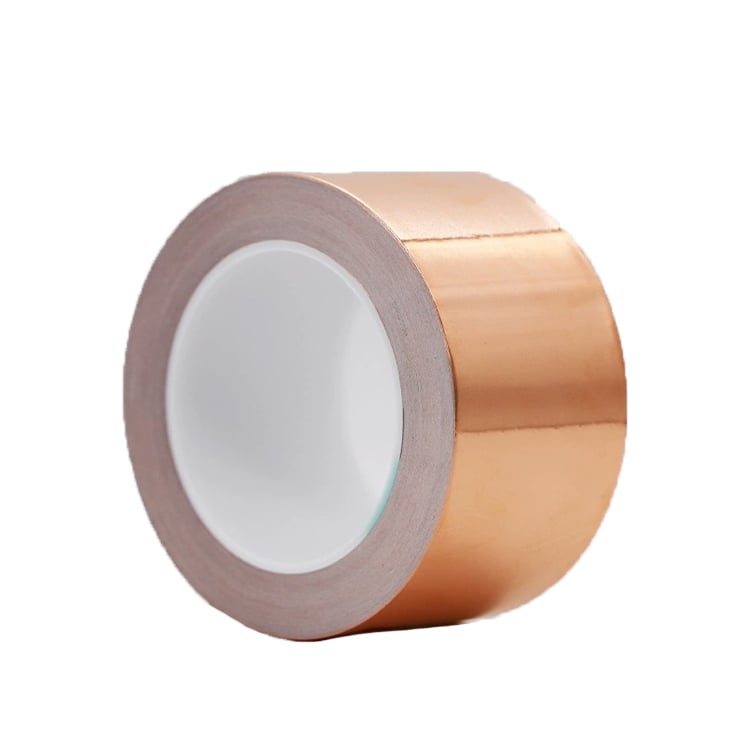
We manufacture copper foil tape on the same Hunan line, so we don't have a dog in this fight. The short version:
- Aluminum is roughly a third the price of copper, lighter, and doesn't tarnish. It's the right call when you need a large-area shield — a full internal chassis liner, a wide cable wrap — and you don't need copper's skin-effect performance above a few gigahertz. It's also what you want when thermal spreading matters, because aluminum's thermal conductivity is in the same league as copper's at a fraction of the weight.
- Copper wins on high-frequency shielding, on low-impedance grounding buses, and on any joint that has to survive high-current fault events. If your shield needs to carry hundreds of amps to chassis ground, use copper.
If you're below ~3 GHz and covering a big area, aluminum is usually the right answer. If you're not sure, send us the frequency and the current — we'll recommend.
The oxide layer thing nobody puts in the catalog
Here's the detail most converted-tape suppliers skip. Aluminum forms a thin, insulating aluminum-oxide layer the moment it hits air. Slap a standard acrylic adhesive on top and the bond is purely mechanical: it sticks, but it's not electrically conductive through the adhesive, and the contact resistance creeps up over years in humidity.
Our aluminum foil tape uses a conductive acrylic adhesive loaded with nickel-coated graphite particles that bite through the oxide layer on bond. That's why the through-resistance stays flat over 1,000 hours at 85 °C / 85% RH, instead of drifting upward the way it does on a generic converted roll. We've tested both side by side, and the difference is visible on a four-wire milliohm meter after a humidity soak.
About the "electrical insulation" in the product name
The standard conductive build is conductive on both sides. If you actually need one face conductive (for grounding and shielding) and the other face insulating (so you don't short adjacent traces or a live pin), we laminate the aluminum foil to a 25 µm PET or PI film before coating the adhesive. That's the build that goes on the back of a display, over a flex circuit, or around a connector where the outer face can't be allowed to contact something live. Tell us which side needs to be insulated; we'll build it that way and mark the liner so your assembly team doesn't peel the wrong one.
Where this tape earns its place
We'll skip the generic "aerospace, medical, military" list. These are the four jobs we ship this build into every week:
- Power module and MOSFET heat spreading plus EMI containment. A foil patch over a switcher IC or a power inductor pulls heat laterally into the chassis while containing the 100 kHz–300 MHz switching noise. We ship this build into on-board charger (OBC) and DC-DC converter customers.
- Cable bundle wrap. A 25 mm spiral wrap on a motor cable or an I/O bundle contains the common-mode noise that otherwise radiates off the shield drain — the exact failure that shows up as a radiated-emissions spike in the 30–300 MHz band.
- Display backside liner. Laptops and tablets put a full aluminum foil liner behind the LCD to both spread heat from the backlight and keep the display quiet to the touch. The insulated-foil build is what we recommend here, because the display stack lives on the other side.
- Low-cost large-area chassis liner. When a fabric tape would cost too much to cover a whole plastic enclosure, a 0.05 mm aluminum foil liner covers the inside for a fraction of the FOF price — and gives you a real conductive surface to which you can ground other parts.
Why Johan coats this in-house
We coat this on the same Hunan line that runs our conductive fabric and PI tapes — 10,000 m² of coating capacity. The foil is 8011 or 1145 grade, annealed to a temper that lays flat without springing back off the roll, and the conductive adhesive is cross-linked so it doesn't ooze out the edge at 80 °C. Because we also convert copper foil tape in the same plant, we'll honestly steer you to copper when that's the better material — we won't quote you an aluminum roll that fails at 4 GHz just because it's cheaper.
We're IATF 16949 certified, so if this lands in an OBC, a LiDAR enclosure, or a motor drive, the PPAP file and lot traceability are already in English.
Working with us
- Standard foil thickness 0.05 / 0.10 mm; widths slit from 3 mm to 500 mm; die-cut patches and custom outlines cut to your DXF. First articles leave Dongguan in 7–10 working days.
- Tell us: which face needs to be insulating, the continuous temperature, the surface you're bonding to, and whether the shield has to carry fault current. We'll recommend foil thickness, adhesive system and whether you should actually be looking at copper.
- Storage: 12 months at 18–26 °C, 45–65% RH, FIFO. We pack on silicone release liner in static-shielding PE.
If your power module needs both heat spreading and EMI suppression, or your large-area shield is running up a copper-foil BOM, send us the layout. We'll tell you whether aluminum foil tape clears it, or whether you're actually sizing a copper foil build, a fabric tape, or a full FOF gasket — and we'll put numbers on both the thermal budget and the shielding budget before you cut tooling.
Typical Values — Conductive Aluminum Foil Tape
Representative values, not for specification purposes.
Item |
Typical value |
Foil grade |
8011 / 1145 annealed aluminum |
Foil thickness |
0.05 / 0.10 mm (custom on request) |
Adhesive |
Conductive acrylic, nickel-graphite filled |
Surface resistance |
< 0.05 Ω / sq |
Shielding effectiveness |
60 dB (10 MHz – 3 GHz, typical) |
Thermal conductivity |
~205 W / mK (aluminum substrate) |
Standard widths |
3 mm – 500 mm |
Operating temperature |
−20 °C to 120 °C long-term |
Insulated-face option |
Laminated 25 µm PET / PI film on request |
Compliance |
RoHS, REACH |
Stepping up: copper foil tape for high-frequency / fault-current grounding, Ni/Cu fabric tape for flexing parts, carbon sponge for cabinet ESD sealing. Tell us the frequency and gap — we'll match the part to the job.