EN







The seam the EMC simulation doesn't catch
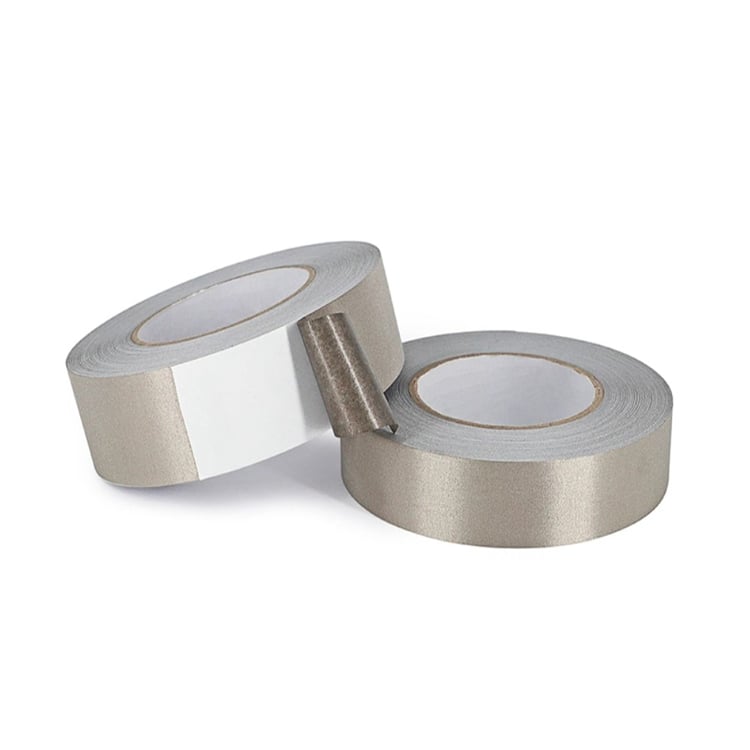
EMC simulation tools are good at predicting what happens inside a shielded metal enclosure. They're terrible at predicting what happens at the seam. When your housing is plastic — and most consumer electronics housings are — the whole enclosure is transparent to RF, and the only thing standing between your radio and a failed radiated-emissions test is a piece of conductive material inside the case. That's where the black conductive shielding fabric tape earns its keep. It's a polyester taffeta plated with nickel over copper, coated with a conductive acrylic adhesive, and slit to whatever width you actually need. You stick it along the chassis seam, over a cable exit, or across a plastic wall that needs to suddenly behave like a Faraday surface, and the enclosure starts performing like it's metal.
This isn't a foil tape. A 50 µm copper patch looks great on a bench and fatigues the moment you put it on a hinge, a sliding camera, or a foldable. The fabric build flexes because the substrate is a textile — that's the whole reason to reach for conductive fabric tape instead of foil on any part that moves.
Why the black nickel finish
The black nickel top coat isn't a cosmetic afterthought. Most plated fabric on the market ships with a gold or amber flash that looks like a repair hack the moment a service technician opens the case. The black finish is what lets this tape live in a visible internal chassis — a laptop palmrest, a TV bezel, a game-console mid-frame — without shouting "EMC band-aid." Nickel also doesn't tarnish the way silver does, and it costs a fraction of a gold plate, so the ground contact stays stable over a five-year product life without the per-roll price of gold-plated taffeta.
The construction is the same 0.08 or 0.12 mm Ni/Cu polyester taffeta we wrap our FOF gaskets in — but delivered as a tape on a silicone release liner. Surface resistance runs under 0.05 Ω/square, shielding effectiveness holds above 70 dB from 10 MHz to 3 GHz, and the conductive acrylic backing bonds to polycarbonate, ABS, magnesium alloy and painted surfaces without extra surface prep.
Where this tape actually gets used
We'll skip the generic "aerospace, medical, military" list. These are the four jobs we ship this build into every week:
- Internal chassis seam grounding on phones, laptops, game consoles. A 3–5 mm strip along the parting line where the top and bottom case meet turns two plastic halves into a continuous conductive surface. It's cheaper than a machined shield can and far easier to service — just peel and re-stick.
- 5G wireless charging and Qi pad shielding. Between the Tx coil and the plastic housing, a layer of fabric tape suppresses the stray magnetic field that would otherwise heat up metal objects sitting on the pad and bleed into the radio. We ship this build into consumer wireless chargers and, increasingly, EV wireless charging pads.
- High-speed I/O shielding around HDMI, USB4 and antenna feed-throughs. A cut-to-shape patch over the connector shell contains the common-mode current that otherwise radiates off the cable shield — the exact failure that costs you a CE or FCC retest.
- Cable drain and flex-circuit grounding. On a hinge flex, a sliding camera module, or a foldable interconnect, the fabric survives hundreds of thousands of open/close cycles because the textile bends instead of work-hardening like a foil would.
- Cabinet and rack grounding in networking gear. Wide-width tape (up to 500 mm) across rack-plate seams and cable entry points, where finger stock would be over-engineered and a gasket wouldn't conform.
On ESD and RFI, honestly
The marketing line on this category is "full EMI / ESD / RFI protection" — which is technically true and practically meaningless. What the tape actually does:
- EMI shielding: attenuates radiated fields above ~30 MHz once you've made a continuous conductive path. At lower frequencies you need a magnetic alloy, not a fabric tape.
- ESD dissipation: the Ni/Cu surface bleeds static off the chassis before it walks onto a sensitive CMOS line. It's not an ESD vent — it doesn't vent gases — but it will safely ground a plastic enclosure that was otherwise insulating.
- RFI containment: contains the switching noise from a DC-DC converter or a high-speed SerDes pair once you've wrapped or patched it. It won't fix a layout problem; it just buys you the 6–10 dB you're short of passing the test.
If you're below 30 MHz, or you need a real gas-venting EMI vent, call us — we'll redirect you to a different part of the catalog rather than oversell this roll.
Why Johan coats and plates this in-house
A lot of "EMI fabric tape" on the market today is a converted imported roll: someone buys plated taffeta in Korea or Japan, coats adhesive on a secondhand line, and reslits it. We run our own magnetron sputtering line in Shandong — continuous roll-to-roll gold, tin and nickel plating on fabric — and we've done it since 2020, when we became the first domestic supplier to plate onto fabric at production scale. The adhesive is coated on our Hunan plant (10,000 m² of coating capacity), and slitting and die-cutting happen in Dongguan.
What that means in practice: when your shielding effectiveness drops 5 dB between lots, we don't route the complaint through three middlemen. The plating engineer who set that lot is on the call. It also means we can tweak the finish — a deeper matte black, a brighter nickel, a thinner coat — without a three-month tooling lead time. And if your application genuinely needs gold plating (corrosive environment, high-frequency contact resistance, or medical), it comes off the same roll-to-roll line, not a special order.
Working with us
- Standard widths slit from 3 mm to 500 mm; die-cut patches, frames and custom outlines cut to your DXF. First articles leave Dongguan in 7–10 working days.
- Send us the surface you're bonding to (PC/ABS? painted? magnesium?), the flex-cycle count if any, and the frequency band you're actually worried about. We'll recommend taffeta weight and adhesive system rather than just quoting the catalog.
- RoHS and REACH compliant. If the tape ends up in a vehicle — LiDAR enclosure, on-board charger, radar housing — we're IATF 16949 and the PPAP file is already in English.
- Storage: 12 months at 18–26 °C, 45–65% RH, FIFO. We pack on silicone release liner in static-shielding PE so the adhesive doesn't pick up dust on your SMT line.
If your radiated-emissions failure is sitting at a seam, on a flexing part, or on a plastic enclosure that should have been metal, send us the failure photo. We'll tell you whether a 3 mm strip of black nickel fabric tape closes the gap, or whether you're actually sizing a shield can, a copper foil patch, or a full FOF gasket — and we'll put numbers on the shielding budget before you cut tooling.
Typical Values — Black Ni/Cu Conductive Fabric Tape
Item |
Typical value |
Substrate |
Ni/Cu plated polyester taffeta, black nickel finish |
Fabric thickness |
0.08 / 0.12 mm |
Surface resistance |
< 0.05 Ω / sq |
Shielding effectiveness (10 MHz – 3 GHz) |
70 dB |
Adhesive |
Conductive acrylic, pressure-sensitive |
Standard widths |
3 mm – 500 mm (custom slit on request) |
Operating temperature |
−20 °C to 80 °C long-term |
Compliance |
RoHS, REACH |
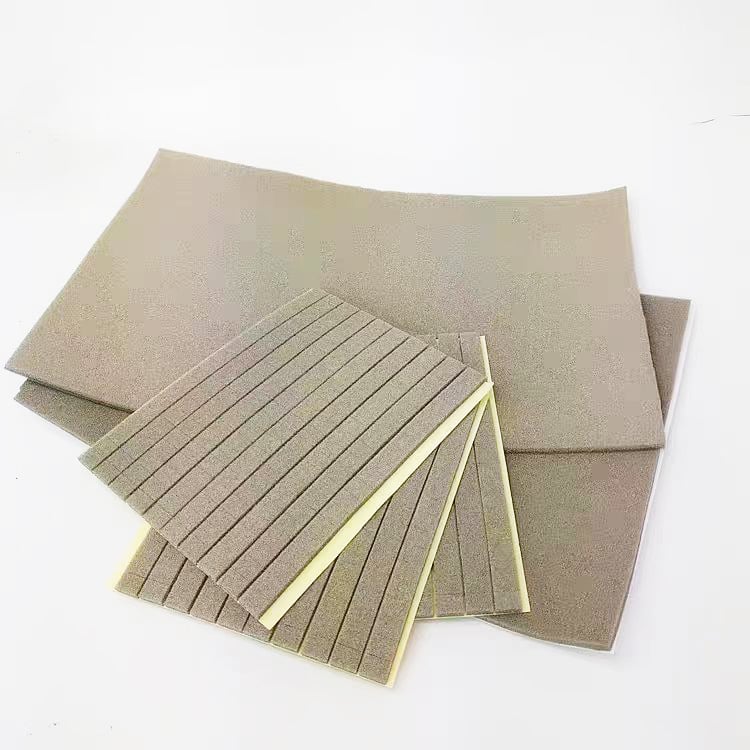
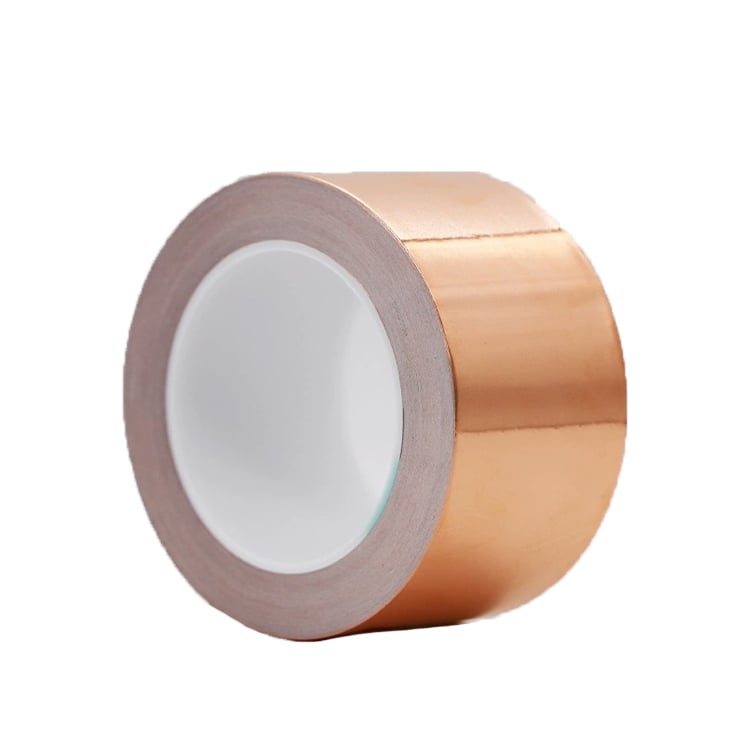
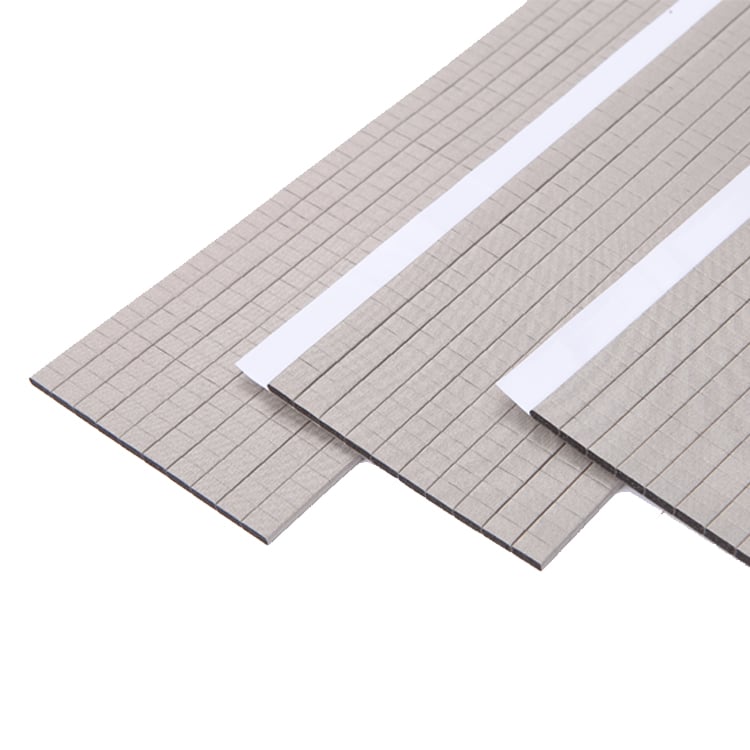
Other builds available: gold-plated taffeta (GP), copper foil tape, aluminum foil tape, conductive sponge foam gasket tape. Tell us the frequency band and the surface — we'll recommend the right one.